
Fertilization
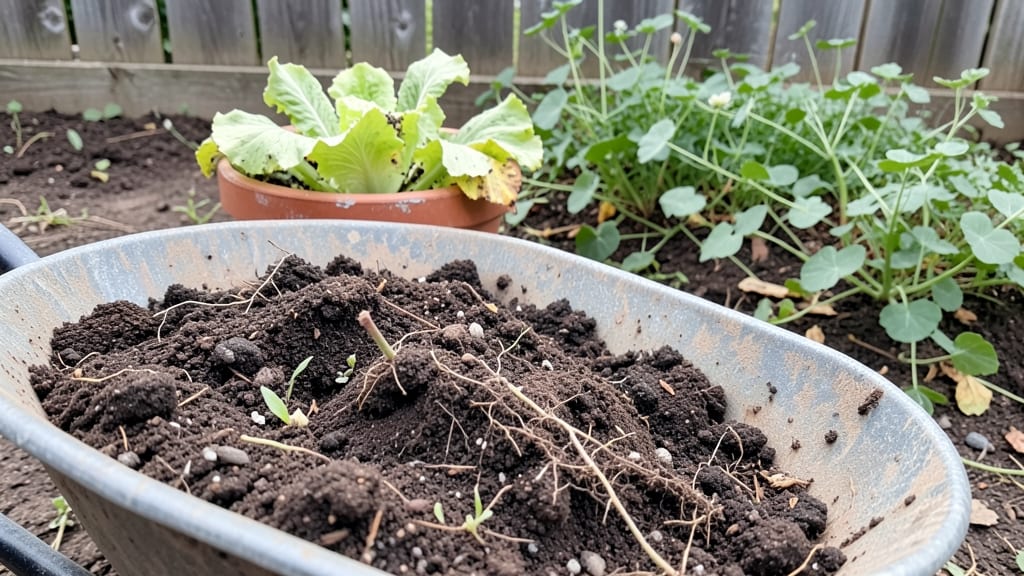
Garden soil simply wasn’t designed for containers—its dense structure smothers delicate roots, trapping excess moisture that leads to rot. 🌱 The tiny particles pack together like a concrete slab, cutting off oxygen while also creating a breeding ground for fungus gnats and pathogens.
Even "amending" it with sand can create a poor texture that drains too fast or too slow, depending on the ratio.
For containers, you need something fluffy and porous—think of it like giving your plants a breathable, well-drained home. That’s why commercial mixes blend ingredients like perlite (for aeration) and coco coir (for moisture control), while DIY mixes often include composted bark or worm castings for nutrients without the compaction risks.
💡 In This Article
- Why Garden Soil Fails as Potting Mix
- Best Soil Alternatives for Potting Plants
Why garden soil fails as potting mix
Here's what's actually happening when you use garden soil in containers: its particles are 2-5 times denser than ideal potting mixes. Garden soil typically contains 40-60% clay, which binds tightly when wet, creating a suffocating environment for roots.
This compaction reduces pore space by 30-50% compared to lightweight potting mixes, where air-filled spaces should make up 20-30% of the volume for optimal oxygen flow to roots.
The science gets even more specific when you examine moisture retention. Garden soil holds water like a sponge, with 10-20% higher water content at field capacity than potting mixes.
This creates anaerobic pockets where roots suffocate, while also promoting fungal growth. 🌱 The microbial activity shifts dramatically too—garden soil's dense structure supports 10x more pathogenic bacteria per gram than sterile potting mixes, creating a perfect storm for root rot and damping-off diseases in seedlings.
What most people don't realize is how this affects nutrient availability. The tightly packed particles in garden soil create nutrient immobilization zones, where essential elements like nitrogen and phosphorus bind to clay particles and become unavailable to plants.
Potting mixes, on the other hand, are designed with 5-10% organic matter (like compost) that releases nutrients gradually through microbial activity, while their loose structure prevents leaching during watering.
Consider this comparison: A standard garden soil has a bulk density of 1.2-1.6 g/cm³, while ideal potting mixes measure 0.3-0.6 g/cm³. This means garden soil weighs 2-5 times more per volume, putting excessive pressure on container roots.
The difference is like trying to grow plants in concrete versus a breathable mesh—one suffocates, while the other thrives.
Even when garden soil appears "loose," its structure collapses under watering. Each time you water, the clay particles reorient and pack tighter, reducing pore space by 15-25% permanently. This explains why plants in garden soil often show symptoms of overwatering even when you think you're being careful with irrigation.
The root health consequences are dramatic: plants in garden soil show 30-50% less root growth compared to those in proper potting mixes.
The restricted oxygen supply forces roots to grow in dense, gnarled patterns rather than spreading out efficiently. 💫 This limited root system means plants can't absorb water or nutrients effectively, leading to stunted growth and poor flowering.